On this page
- CodeScene Pioneered Git Intelligence, But at Enterprise Prices
- What CodeScene Excels At
- Hotspot Analysis and Code Health
- Organizational Analysis
- Code Review Automation
- What CodeScene Doesn't Do
- No AI-Generated Documentation
- No MCP Server for AI Agents
- No Semantic Search
- No Dependency Graph Visualization
- Not Open Source
- repowise: Git Intelligence + AI Docs + MCP in One OSS Package
- Hotspot Analysis (Churn x Complexity)
- Auto-Generated Wiki for Every File
- Ten MCP Tools for Claude Code, Cursor, Cline
- Dependency Graph With PageRank
- Feature Comparison Table
- Pricing: Free OSS vs Enterprise Licenses
- Migration Path: CodeScene to repowise
- Key Takeaways
- FAQ
- Is repowise really a "free" alternative to CodeScene?
- Does repowise support the same languages as CodeScene?
- Can I use repowise for security auditing?
CodeScene is the more established behavioural code analysis product, and it is the safer pick if a validated dashboard is what you are buying. repowise covers the same hotspot, bus factor and ownership ground, adds generated docs and an MCP server your agents can query, and is AGPL-3.0, so you can self-host it at no licence cost.
CodeScene has one correct insight at its core: complexity alone doesn’t tell you which files to worry about. A complex file untouched for three years is stable. The same complexity on a file edited five times a week is a hotspot. This distinction, from Adam Tornhill’s Your Code as a Crime Scene, is the right question to ask.
The trouble is what CodeScene delivers as its answer. A dashboard. Your AI agent can’t query it. There’s no documentation layer, no semantic search, no way for Claude Code or Cursor to ask "what does this module actually do?" Behavioral analysis was the right first move. It doesn’t finish the job.
For many teams, CodeScene’s enterprise pricing and closed-source nature have become barriers. The demand for a CodeScene alternative that combines Git forensics with AI documentation and agent tooling has grown accordingly.
CodeScene Pioneered Git Intelligence, But at Enterprise Prices
CodeScene, built on the research of Adam Tornhill (author of Your Code as a Crime Scene), changed how we think about technical debt. Before CodeScene, teams looked at static analysis: linting errors and cyclomatic complexity. CodeScene showed that complexity only matters if you actually have to touch that code frequently.
A complex file that hasn't been changed in three years is a "stable" asset. A complex file that changes five times a week is a "hotspot." This distinction matters when prioritizing refactoring.
But as a legacy enterprise tool, CodeScene comes with significant baggage:
- Cost: Pricing scales by seats and repository size, often putting it out of reach for smaller teams or open-source projects.
- Siloed Intelligence: The insights live in a dashboard, separate from your IDE or your AI agents.
- Closed Ecosystem: You cannot easily extend the platform or self-host it without significant enterprise overhead.
What CodeScene Excels At
Before looking at alternatives, understand what CodeScene actually does well.
Hotspot Analysis and Code Health
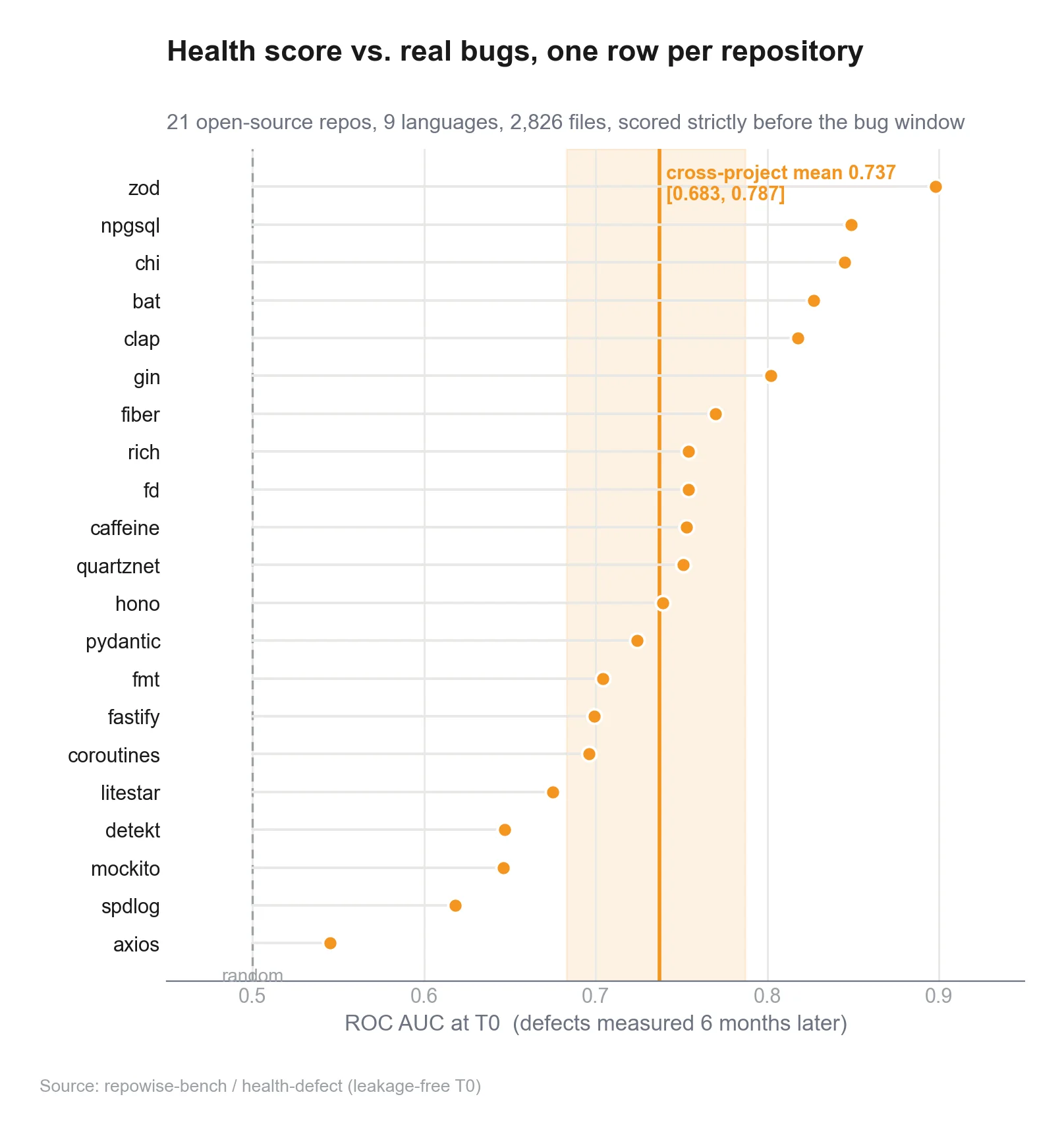
CodeScene’s primary value proposition is its "Hotspot" map. It calculates a "Code Health" score by looking at factors like deeply nested logic, brain methods, and high cyclomatic complexity, then overlays this with "Churn" (how often the file changes). This creates a clear priority list for refactoring. repowise takes a related but distinct approach: instead of one blended Code Health number, it scores every file across three co-equal signals, defect risk, maintainability, and performance, so a file that is hard to read but rarely buggy doesn't get lumped in with one that is actively producing incidents. That split matters most in exactly the prioritization conversation CodeScene's Hotspot map is built for.
Organizational Analysis
Because CodeScene mines Git metadata, it can see who is working on what. It identifies "Knowledge Islands" (files only one person understands) and calculates the "Bus Factor." This is invaluable for engineering managers trying to mitigate the risk of key developers leaving.
Code Review Automation
CodeScene can plug into your PR workflow to warn you if a change is being made to a particularly fragile hotspot, acting as a high-level gatekeeper for code quality.
To be direct: if your team needs an established product with enterprise SLAs, a dedicated customer success track, and UI polished for non-technical stakeholders, CodeScene is the stronger choice. The CodeHealth metric has years of calibration against real codebases. The behavioral analysis research is peer-reviewed. For teams that have already budgeted for it and value that track record, switching costs are real.
What CodeScene Doesn't Do
While CodeScene is excellent at forensics, it lacks the "intelligence" required for modern development workflows. It can tell you that a file is a problem, but it can’t tell you what the file does or how to fix it using AI.
No AI-Generated Documentation
CodeScene shows you the "where," but not the "what." It doesn't generate documentation. repowise uses LLMs to generate a detailed wiki for every file, module, and symbol. You can see auto-generated docs for FastAPI to understand the level of detail that is missing from traditional forensics tools.
No MCP Server for AI Agents
The biggest shift in software engineering in 2025 is the Model Context Protocol (MCP). AI agents need a structured way to "read" your codebase. CodeScene is a UI-first tool; it doesn't provide a standardized API for agents like Claude or Cline to query your architecture.
No Semantic Search
CodeScene uses traditional indexing. It doesn't support vector-based semantic search (e.g., "Find the logic responsible for handling JWT expiration"), which is a core requirement for navigating large, unfamiliar codebases.
No Dependency Graph Visualization
Understanding how a change ripples through a system requires a deep understanding of imports and dependencies. While CodeScene has some architectural views, it lacks the rigorous graph-theory approach (PageRank, community detection) needed to identify central bottlenecks in the code.
Not Open Source
CodeScene is proprietary. For teams handling sensitive intellectual property, the ability to self-host an open source CodeScene alternative under a license like AGPL-3.0 is a matter of security and compliance.
 Feature Comparison Matrix
repowise: Git Intelligence + AI Docs + MCP in One OSS Package
repowise was built to fill the gap between traditional git forensics and the new world of AI-native development. It is designed to be the "brain" of your codebase, providing both the forensic data of a technical debt tool and the context needed by AI agents.
Hotspot Analysis (Churn x Complexity)
repowise replicates the core value of CodeScene by mining your Git history. It identifies high-churn files and correlates them with complexity metrics across the 11 full-tier languages (Python, TypeScript, Go, Rust, etc.). You can explore the hotspot analysis demo to see how repowise visualizes risk.
Auto-Generated Wiki for Every File
The "Wiki" is the heart of repowise. Instead of manual READMEs that go out of date, repowise uses LLMs (OpenAI, Anthropic, or local Ollama models) to document every file. It assigns a "freshness score" and "confidence rating" to each entry, ensuring you know when the docs might be lagging behind the code.
Ten MCP Tools for Claude Code, Cursor, Cline
This is the "killer feature" for modern devs. repowise exposes its entire intelligence engine via the Model Context Protocol, as ten flagship tools. When you use an agent like Claude Code, it can call specific tools to understand your repo:
get_overview(): High-level architecture and tech stack.get_context(): Deep dive into specific files or symbols.get_risk(): Identifies hotspots and co-change patterns.get_change_risk(): Scores the defect risk of a commit or abase..headdiff range from the shape of the change itself, before merge.search_codebase(): Semantic search using LanceDB or pgvector.
By providing these tools, repowise moves codebase intelligence from a passive dashboard into an active participant in your coding session. get_change_risk() in particular has no CodeScene equivalent: CodeScene's Code Health score tells you a file is historically fragile, but it can't score a specific pending diff before you merge it. Paired with repowise's decisions layer, which records and surfaces why a piece of architecture was built the way it was, an agent can check both whether a change is risky and whether it violates a documented decision, in the same session, without leaving the editor. You can learn about repowise's architecture to see how the MCP server integrates with the core engine.
 MCP Tool Registry
Dependency Graph With PageRank
Understanding code is about understanding relationships. repowise parses imports to build a directed dependency graph. It applies PageRank to find the most "important" files in your repo and community detection to find logical modules that may not be reflected in the folder structure. Try the FastAPI dependency graph demo to see this in action.
Feature Comparison Table
| Feature | CodeScene | repowise |
|---|---|---|
| Hotspot Analysis | Advanced (Behavioral) | Advanced (Churn x Complexity) |
| Bus Factor Detection | Yes | Yes |
| AI Documentation | No | Yes (LLM-generated Wiki) |
| MCP Support | No | Yes (Ten Structured Tools) |
| Semantic Search | No | Yes (LanceDB/pgvector) |
| Architecture Diagrams | Limited | Yes (Mermaid.js generation) |
| Dead Code Detection | No | Yes (Unused exports/files) |
| Self-Hostable | Enterprise Only | Yes (Docker/Source) |
| License | Proprietary | AGPL-3.0 (Open Source) |
Scroll the table sideways to see every column.
Pricing: Free OSS vs Enterprise Licenses
The most significant difference for many will be the cost. CodeScene's pricing is opaque and scales with your team size. For a medium-sized engineering org, this can easily run into thousands of dollars per year.
repowise is open-source. You can install it and point it at your local or private repositories today; the pricing page covers the hosted option if you'd rather not run infrastructure.
# Getting started with repowise
pip install repowise
repowise init
repowise init --no-prose gives you a free, deterministic wiki with no LLM API key and no spend, and you can upgrade individual pages with an LLM later. Because it also supports Ollama, you can run the intelligence engine entirely offline when you do want LLM-generated prose, ensuring your code never leaves your infrastructure. That's a meaningful advantage for security-conscious teams looking for a codescene open source alternative.
 repowise System Architecture
Migration Path: CodeScene to repowise
If you are currently using CodeScene and considering a move to an open-source alternative, the process has five steps:
- Audit your current usage: Are you primarily using the Hotspot maps? repowise provides these out of the box.
- Setup repowise: Deploy it as a sidecar to your CI/CD pipeline or on a central internal server.
- Index your repos: Point repowise at your Git URLs. It will begin the initial mining and documentation generation.
- Connect your AI tools: Add the repowise MCP server to your
claude_desktop_config.jsonor Cursor settings. - Compare insights: You’ll likely find that the combination of Git hotspots plus AI-generated context provides a much clearer picture of your technical debt than forensics alone.
Key Takeaways
- CodeScene is a mature, well-validated tool for behavioral code analysis, but its insights live in a dashboard your AI agents can't query.
- repowise offers a codescene free alternative that includes hotspot analysis, bus factor detection, and organizational mapping.
- The inclusion of an MCP Server and AI-generated documentation makes repowise a "living" intelligence platform rather than a static dashboard.
- Being AGPL-3.0 open-source, repowise allows for complete data sovereignty and self-hosting, which is critical for many enterprise security teams.
- By combining dependency graphs, semantic search, and Git intelligence, repowise provides the "Full Stack" of codebase visibility.
If you're paying enterprise rates for a dashboard your AI agents can't query, see what repowise generates on real repos and judge from the output.
FAQ
Is repowise really a "free" alternative to CodeScene?
Yes. The core platform is open-source under the AGPL-3.0 license. You can host it yourself at no cost, other than the compute and any LLM API tokens you choose to use (though local models like Llama 3 via Ollama are also supported).
Does repowise support the same languages as CodeScene?
repowise supports most major languages including Python, JS/TS, Go, Rust, Java, C++, Ruby, and more. It uses Tree-sitter for high-precision parsing, similar to the engines used in modern IDEs.
Can I use repowise for security auditing?
While not a dedicated SAST tool, repowise’s hotspot analysis and dead code detection are excellent for identifying "fragile" areas of the codebase where security vulnerabilities are most likely to hide.