On this page
The best code health tools in 2026 are CodeScene for behavioral hotspot analysis, SonarQube for quality gates across many languages, Codacy for pull request checks, and repowise for an open-source, self-hostable score that also feeds AI agents. The right pick depends on whether you need to find where to spend the next week, enforce a floor on every merge, or both.
The short list, as of October 2026:
- CodeScene: CodeHealth scoring built on change frequency and complexity trends.
- SonarQube: the standard for quality gates on new code, in cloud or self-managed form.
- Codacy: managed analysis with grades, coverage and merge gates on every PR.
- Qlty: the successor to Code Climate Quality, with linting, coverage and trend tracking.
- repowise: open source (AGPL-3.0), a 1 to 10 score per file with a ranked Fix first queue, locally and with no LLM key.
We build repowise, so weigh our entry accordingly. The measurements we publish about it, with their methods, are on the benchmarks page.
How we evaluated
We compared each tool on what a team decides on, using each vendor's own pricing and product pages, fetched on 12 October 2026.
- What the score reads: rules only, or also git history, ownership and test coverage.
- Prioritization: does it say which file to fix first, or only list issues?
- Where it runs: git hosts, IDE, CI, and whether you can self-host.
- Price model: per author, per developer, per lines of code or free, at list price.
We did not benchmark the commercial tools ourselves, apart from the CodeScene comparison described below. Vendor pages change often, so confirm on the linked page before you buy.
What a code health tool should measure
A code health tool should answer four questions: which files are unhealthy now, which are getting worse, which changes touch risky code, and which areas are under-tested or hard to own. Static rules answer the first. History answers the rest.
- Hotspot times complexity. Complexity in a file nobody edits is cheap. Churn in a simple file is harmless. The combination is where cost lands again and again.
- Coverage tied to change. Coverage on a stable file matters less than coverage on a file that changes weekly.
- Trend detection. A file sliding from 8 to 6 over five scans is a better signal than a static 6.
- Drill-down. A repository number hides a few rotten modules behind a green average, so the tool must go repository, module, file.
For the full model, see the complete code health guide.
Comparison table
| Tool | Score | Reads git history | Hotspots | Coverage | Self-host | Agent access (MCP) | Starting price (October 2026) |
|---|---|---|---|---|---|---|---|
| CodeScene | CodeHealth | Yes | Yes | Pro plan | Yes, on-prem | No | Free for open source; Standard EUR 18 per active author a month, annual |
| SonarQube | Quality gates and ratings | Limited | No | Yes, on new code | Yes, Server editions | No | Free to 50k lines; Team from $34 a month |
| Codacy | Grades per repo and file | Limited | No | Yes | Cloud only on Team | No | Free for open source; Team $18 per developer a month, annual |
| Qlty | Maintainability and trends | Trend tracking | No | Yes | Cloud | No | Free; Pro $20 per contributor a month |
| repowise | 1 to 10 per file, three signals | Yes | Yes | Yes, from your reports | Yes, open source | Yes, ten tools | Free and self-hosted; hosted Free for public repos |
Scroll the table sideways to see every column.
1. CodeScene
CodeScene is the best-known behavioral code analysis platform, combining its CodeHealth metric with hotspots mined from git history.
- Where it shines: prioritization. It weights complexity by how often a file changes, so a team can name the few areas that cause most of the rework. Its CodeHealth metric aggregates many code factors, and Standard includes automated code reviews and IDE monitoring across 30+ languages.
- Pricing as of October 2026: Standard EUR 18 and Pro EUR 27 per active author a month, billed yearly. An active author is anyone who committed in the past three months. Pro adds portfolio, team and delivery insights and coverage. Enterprise is custom, there is a free Community Edition for open source, and an on-prem deployment is available (pricing).
- Pick it if you want the most established behavioral technical debt platform and per-author SaaS or on-prem pricing suits you.
2. SonarQube
SonarQube is the default for code quality gates in CI, covering many languages and rule types.
- Where it shines: enforcement. Its quality gates set conditions on new code such as coverage, duplication and ratings, so a pull request that crosses the line fails. It runs as SonarQube Cloud or self-managed SonarQube Server.
- Pricing as of October 2026: free up to 50k lines of code. Cloud Team starts at $34 a month for fewer than 50 developers, and Enterprise is custom. SonarQube Server Developer, Enterprise and Data Center editions are priced per instance by lines of code. Public open source projects are free (pricing).
- Pick it if you want a familiar gate on every merge and broad rule coverage more than behavioral prioritization.
3. Codacy
Codacy is a managed analysis service that grades repositories and files and gates pull requests.
- Where it shines: setup. It runs on GitHub, GitLab and Bitbucket with no CI pipeline integration, reports coverage and complexity, and adds an AI reviewer and merge gates on the Team plan (pricing).
- Pricing as of October 2026: a free Developer IDE plugin. Team is $18 per developer a month annual ($21 monthly) for up to 30 developers and 100 private repositories. Business is custom, adds SSO and audit logs, and open source is free.
- Pick it if you want PR-time guardrails with little to maintain.
4. Qlty
Qlty is the product Code Climate Quality users are directed to: linting, formatting, coverage and security scanning around the pull request.
- Where it shines: a low-friction entry. The Free plan includes 1,000 analysis minutes a month, and Pro adds analytics and trend tracking for the whole team (pricing). Code Climate's own documentation says Quality is being replaced by Qlty Cloud and points new users there.
- Pricing as of October 2026: Free, Pro $20 and Enterprise $30 per contributor a month. Open source qualifies for free service.
- Pick it if you used Code Climate Quality and want the maintained successor, or you want linting and coverage in one pull request workflow.
5. repowise
repowise scores every source file from 1 to 10 from the parse tree, the dependency graph and git history, and ranks a Fix first list of what to change. It runs inside repowise init and repowise update with no LLM key or network.
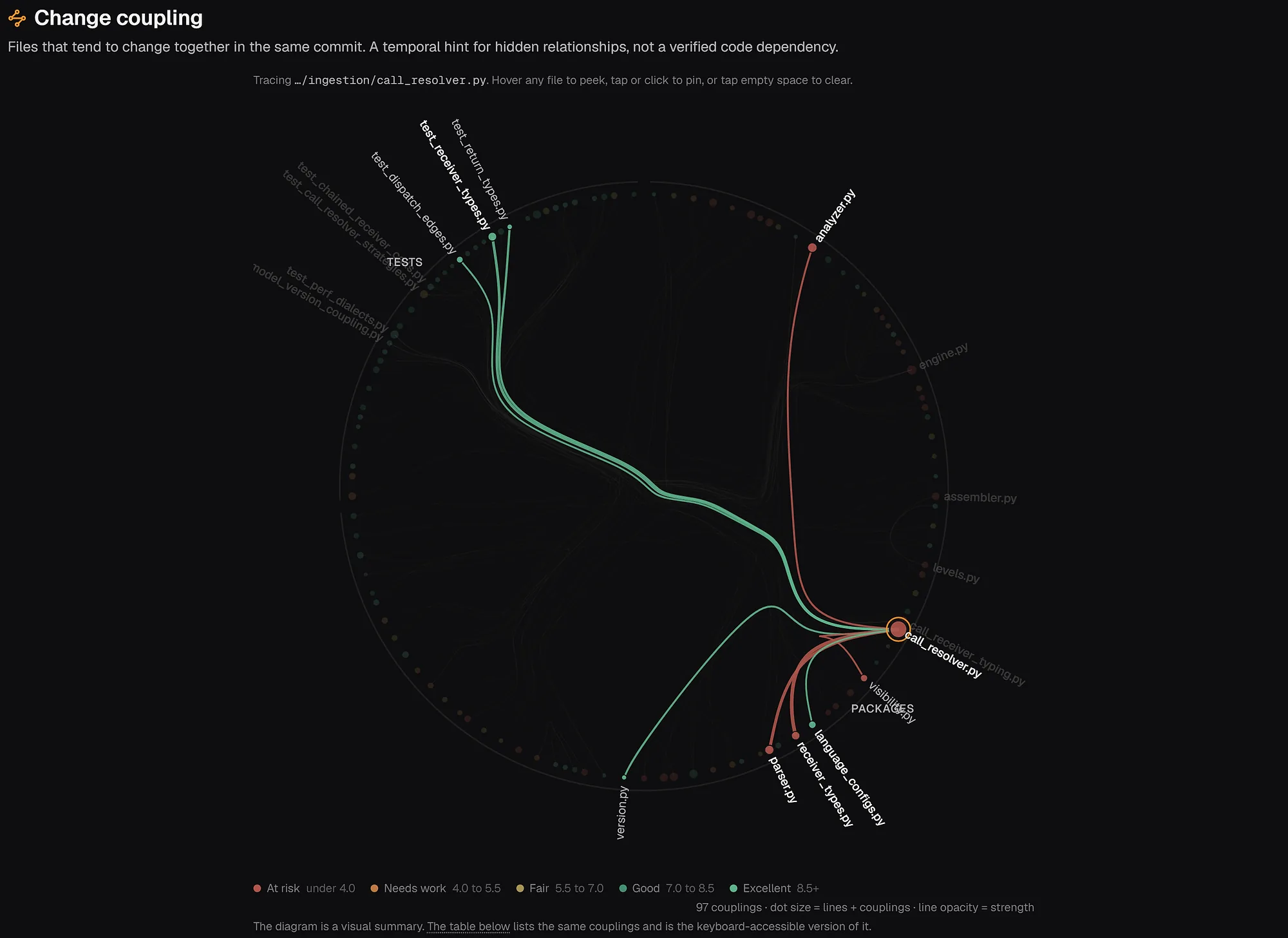
- Where it shines: three signals kept apart. Defect risk is the headline score, maintainability and performance risk are reported separately, and none are blended. 53 detectors feed them, and bands are absolute, so a 6.2 means the same in every repository. Hotspots, ownership, co-change, coverage reports and declining-health alerts sit in the same system, and ten MCP tools expose it to coding agents.
- Evidence: scored before the bug window, the file score predicts which files get bug-fixed over the next six months with a ROC AUC of 0.74 across 21 repositories. Against CodeScene on the same files, it surfaces 2.3x the defects under a fixed 20%-of-lines review budget. The method and numbers are in the validation study and the published benchmarks.
- Pricing as of October 2026: the engine is open source under AGPL-3.0 and free to self-host. Hosted Free covers two public repositories. Private repositories are on Pro.
- Pick it if you want one open system for health, hotspots and agent access that runs on your own machine. See it live on the FastAPI code health page.
repowise init             # full index; scores every file
repowise health           # Fix first, KPIs, lowest-scoring files
repowise health --trend   # the last 10 snapshots
repowise health --badge   # README badge markdown
How to choose
Start from the job: enforcement, prioritization or both. Then check hosting and price.
| If you need... | Shortlist |
|---|---|
| A quality gate on every merge | SonarQube, Codacy |
| Hotspots and prioritized technical debt | CodeScene, repowise |
| Code that stays on your infrastructure | SonarQube Server, CodeScene on-prem, repowise |
| Lowest cost to start | Qlty Free, SonarQube free tier, repowise self-hosted |
| An open-source engine you can audit | repowise |
| Health data an AI agent can query | repowise |
| A Code Climate Quality replacement | Qlty |
Scroll the table sideways to see every column.
Many teams pair one gate (SonarQube or Codacy) with one prioritization tool (CodeScene or repowise). The gate keeps new code from sliding, and the prioritization tool picks what to refactor.
To evaluate on a real repository: scan one active repo, list the ten hottest files, check whether they also score low, look for coverage gaps in the same places, and confirm the tool flags declines, not only bad snapshots. If a new engineer cannot act on the output without a tour, it is reporting, not helping.
FAQ
- What are the best code health tools in 2026?
- CodeScene, SonarQube, Codacy, Qlty and repowise cover most needs. CodeScene and repowise prioritize by hotspots, SonarQube and Codacy gate pull requests, and Qlty succeeds Code Climate Quality.
- What code health metrics matter most?
- Per-file health, churn, complexity, coverage on changed code, ownership concentration, co-change patterns and declining trends. An aggregate score helps with trendlines, but it must drill down to the files behind it.
- Is code coverage enough for code quality monitoring?
- No. Coverage shows which lines ran, not whether the code is easy to change or the tests are meaningful. Tools pair it with complexity, maintainability or change history.
- What is a good code health score?
- It depends on the scale, since each tool defines its own. In repowise, 8.5 and above is Excellent, 7.0 to 8.5 Good, and under 4.0 At risk, with the same bands in every repository. A good score that is falling deserves more attention than a mediocre stable one.
- Which tool is best for technical debt with git intelligence?
- CodeScene is the established choice for hotspot-driven prioritization. repowise is the open-source alternative, adding ownership, co-change, dead code and MCP tools.
- Can I self-host a code health platform?
- Yes. SonarQube Server and CodeScene on-prem are self-managed commercial options. repowise is AGPL-3.0 and runs locally with
pip install repowise, with no API key for health scoring.