FOR TEAMS
Put the team on one shared body of codebase evidence.
Index each repository once. Give developers, reviewers, and coding agents the same documentation, ownership, risk, and decisions instead of separate personal snapshots.
Hosted Teams: 25 pooled repositories, 6 concurrent index jobs, and owner / admin / member roles.
Review Teams pricing- index per repository
- 1
- pooled repositories
- 25
- monthly LLM credit
- $5 / seat
- concurrent index jobs
- 6
Every active member reads the same team-owned snapshot.
The backend-enforced limit applies to the whole team, not each seat.
Contributed to one centrally billed team balance.
The enforced Teams indexing ceiling.
Shared review evidence
One review can carry the repository context the whole team trusts.
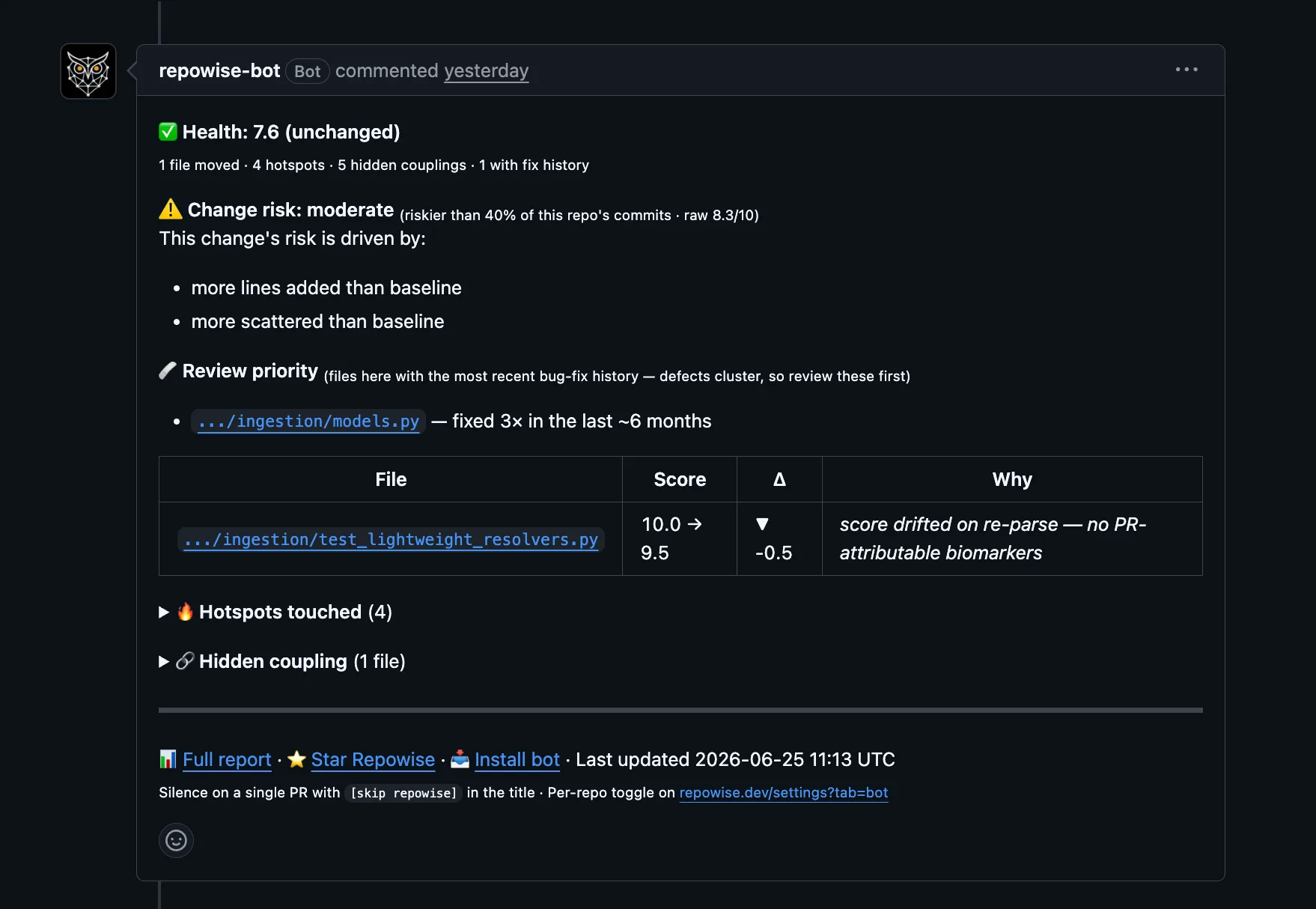
The Repowise PR Bot brings deterministic health, change-risk, affected code, and test evidence into the pull request. It uses the same index the team reads in the product and over MCP, so review does not become a separate intelligence silo.
Capture: a real Repowise PR Bot comment. The bot's deterministic score does not require a model call.
How the index produces it
Shared knowledge becomes an operating workflow.
Teams works when repository context is created once, governed centrally, and available at the same moment a developer, reviewer, or agent needs it.
- 01 / Connect
Install the GitHub App once
An owner or admin connects the organization and controls which private repositories become team-owned indexes. - 02 / Share
Read one current snapshot
Documentation, graph relationships, ownership, health, decisions, and security state come from the same indexed repository for every member. - 03 / Review
Bring evidence into pull requests
Use deterministic risk, dependents, co-change partners, and test evidence before merge, with the same context available to coding agents over MCP. - 04 / Operate
See risk across the portfolio
Portfolio health, ownership concentration, security rollups, audit history, and shared workspaces turn repository facts into team-level operating signals.
Plan or deployment fit
Use Teams when the index becomes shared infrastructure.
Pro remains the individual plan. Teams is for a group that needs pooled repositories, centralized credits and billing, organization roles, shared workspaces, and governance over the same engine.
Individual
Pro
Best for one developer managing up to 5 repositories, a personal GitHub App connection, and a personal credit balance.
Shared
Teams
Starts at 3 seats. $20/seat/month or $16/seat/month billed yearly, with 25 pooled repositories.
Checkout, seat changes, and cancellation keep their existing billing behavior.
Deployment
Enterprise
Evaluate Enterprise when customer-managed deployment, commercial terms, or controls beyond the hosted Teams tier are required.
Honest limitations
Shared evidence does not replace engineering judgment.
Graph reachability is structural evidence, and historical co-change is correlation. Test links are labeled measured, inferred, or unknown. A quiet bot comment is not proof that a change is safe, and portfolio signals should guide review rather than become individual productivity scoring.
Questions, answered
The details behind the claim.
How does Teams billing work?
Teams is billed per seat with a 3-seat minimum: $20/seat/month, or $16/seat/month billed yearly. Every seat contributes $5/month of LLM credit into one shared team pool. Seats and checkout remain managed from the existing billing flow.
What does every member get?
Every active member can use the shared team repositories and their common wiki, graph, health, decisions, chat, and MCP context. Model-backed work draws from the centrally billed team credit pool.
How are repositories shared?
A team repository is indexed once and every active member reads the same snapshot. The 25-repository limit is pooled across the team rather than applied per seat.
What is the difference between Pro and Teams?
Pro is an individual plan with 5 repositories and a personal balance. Teams adds pooled repositories, centralized billing and credits, organization roles, a shared GitHub App installation, portfolio views, governance, and team-owned cross-repository workspaces.
Which roles ship today?
Teams ships owner, admin, and member roles. Owners control billing and the team; admins manage members, repositories, integrations, and credits; members use the shared product surfaces. Broader enterprise RBAC remains a separate planned capability.
What happens if we cancel?
Cancellation and access changes continue to follow the existing billing and entitlement behavior. Team-shared access ends with the paid team state; personal repositories and personal plan state remain separate.
Last reviewed: September 2026
Put the shared repository on one plan and one index.
Review the Teams price, seat minimum, pooled limits, and checkout path in one place.